
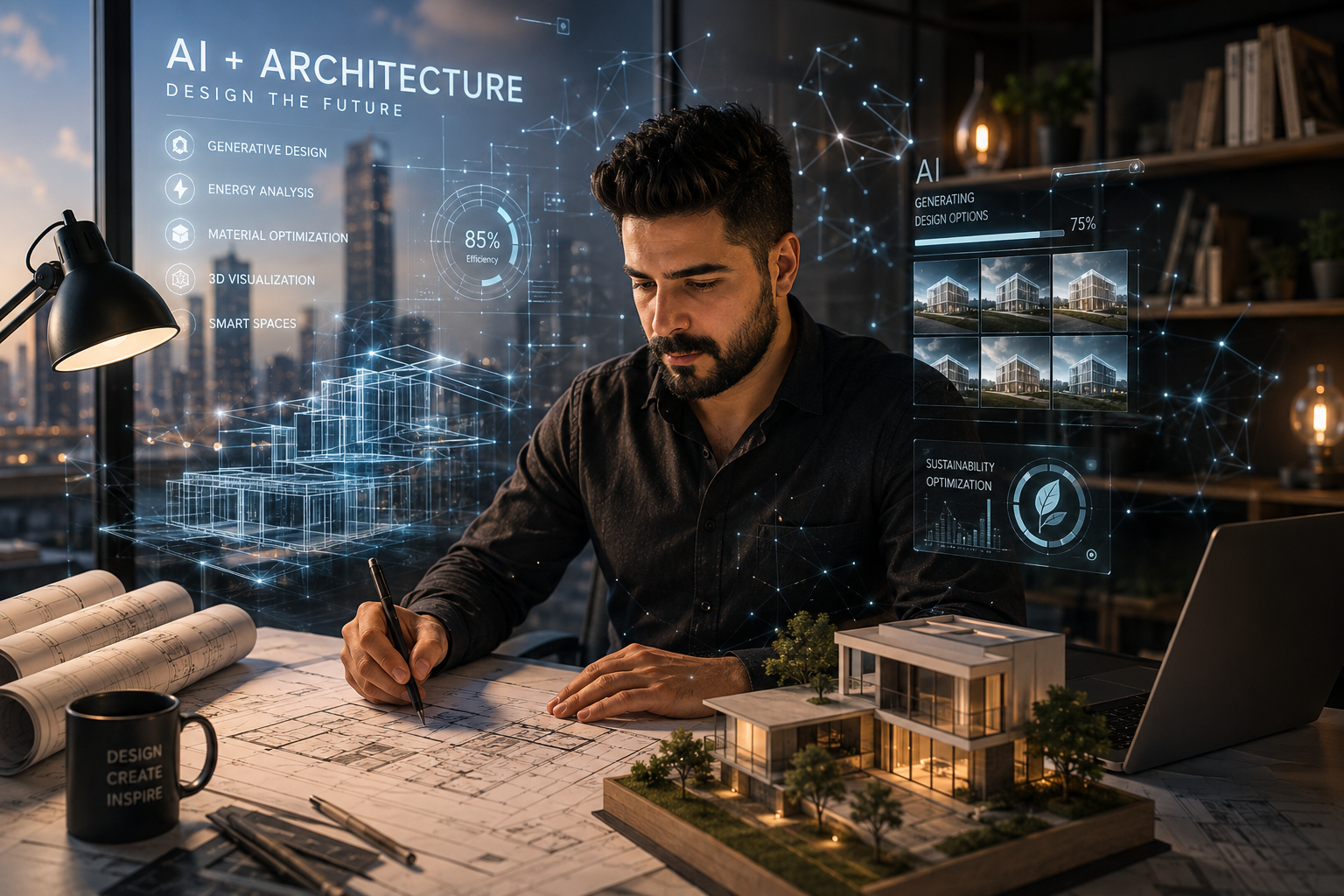
How Artificial Intelligence Changed the Way I Think as an Architect
At the beginning of my journey in architecture, I believed that creativity alone was what truly made the difference between one project and another.
I used to think that architecture started with a sketch, a blank page, and a strong visual imagination capable of transforming ideas into spaces people could actually live in.
But over the past few years, I started noticing a major shift happening inside the world of architecture and interior design.
It was no longer only about software, rendering techniques, or creating beautiful visuals.
The entire way we think as architects began to evolve.
Today, artificial intelligence has become part of the future of architecture itself.
And honestly, at first, I was skeptical.
I believed that real architecture could never come from algorithms, and that technology might eventually create repetitive designs lacking emotion and identity.
But with time, I realized something important:
Technology does not kill creativity.
Architects who stop evolving are the ones who do.
That is why I always relate to Frank Gehry’s famous quote:
“Architecture should speak of its time and place, but yearn for timelessness.”
Great architecture will always reflect its era while still carrying a timeless spirit that endures for decades.
And in many ways, this is exactly what artificial intelligence is bringing into architecture today.
Architecture Is No Longer Just About Aesthetics
For many years, people believed that the role of the architect ended once the design looked visually impressive.
But architecture today has become much deeper than that.
We now think about:
- Human experience
- Emotional comfort
- Natural lighting
- User movement
- Sustainability
- Everyday interaction with space
This is where AI started changing the workflow in a truly powerful way.
Today, we can analyze spaces faster, test multiple design directions within hours, improve lighting and materials instantly, and even simulate how users may interact with a project before it is built.
Yet despite all these advanced tools, I still believe architecture should never be measured only by the quality of a render or the realism of a visualization.
Which is why Mies van der Rohe’s philosophy still resonates deeply with me:
“Less is more.”
Simplicity is never weakness.
True simplicity requires a deep understanding of proportion, light, materials, and the emotional relationship between people and space.
How I Use Artificial Intelligence in My Architectural Process
Personally, I do not see artificial intelligence as a replacement for architects.
I see it as a tool that helps me develop ideas faster and communicate them more clearly.
Sometimes I use AI to build moodboards and visual atmospheres before starting the actual design process.
Other times, it helps me experiment with materials, lighting conditions, and spatial moods within minutes instead of spending endless hours testing options manually.
In several projects, AI has also helped me create cinematic architectural visuals that communicate not only the appearance of a project — but its feeling.
And this is where I noticed something very important:
Clients today are no longer searching only for beautiful designs.
They are searching for experiences.
For emotion.
For identity.
For storytelling.
Architecture presentation itself has changed dramatically.
Drawings alone are no longer enough.
Visual storytelling, cinematic imagery, and emotional presentation have become essential parts of modern architecture.
Will Artificial Intelligence Replace Architects?
This question appears constantly today.
And honestly, I do not believe it will.
Because architecture is not simply about generating images or producing forms quickly.
Architecture is deeply connected to emotion, culture, identity, and human behavior.
Artificial intelligence can generate thousands of design possibilities within seconds…
But it cannot truly feel space the way architects do.
It cannot understand how sunlight transforms a room at a specific hour of the day.
It cannot understand the emotional impact of scale, silence, texture, or atmosphere.
That is why I strongly connect with Norman Foster’s perspective on the future of architecture:
“The future of architecture is not only about buildings, but about creating intelligent experiences.”
The future is not only about constructing spaces.
It is about creating meaningful experiences people can emotionally connect with.
And that is what makes architecture a deeply human profession before anything else.
The Future of Architecture in Oman and the Gulf Region
Across the Gulf region — and especially in Oman — I have noticed a significant shift in how people understand architecture and interior design.
There is now greater appreciation for:
- Spatial identity
- Emotional comfort
- Luxury experiences
- Detail-oriented design
- Human-centered environments
Clients today are no longer looking for spaces that simply “look expensive.”
They want places that feel unique and emotionally memorable.
And with the rise of AI in architecture, the opportunities have become even greater for design studios capable of combining:
- Creativity
- Technology
- Speed
- Visualization
- Strong architectural identity
I truly believe the coming years will completely redefine how architecture is presented, designed, and experienced — especially with the rapid evolution of AI visualization technologies.
Architecture Will Always Remain Human
Despite all the technological advancements happening today, I still believe the best projects never begin with software.
They begin with emotion.
With vision.
With an idea powerful enough to create a meaningful human experience.
Technology will continue evolving endlessly.
But the soul of architecture will always remain deeply connected to people.
And perhaps that is the most beautiful part of this profession.